Technology
7 Signs Your Business Has Outgrown Excel: The Case for Custom ERP Development
U
Uzair Khan
Chief Systems Architect
February 20, 2026
3 min read
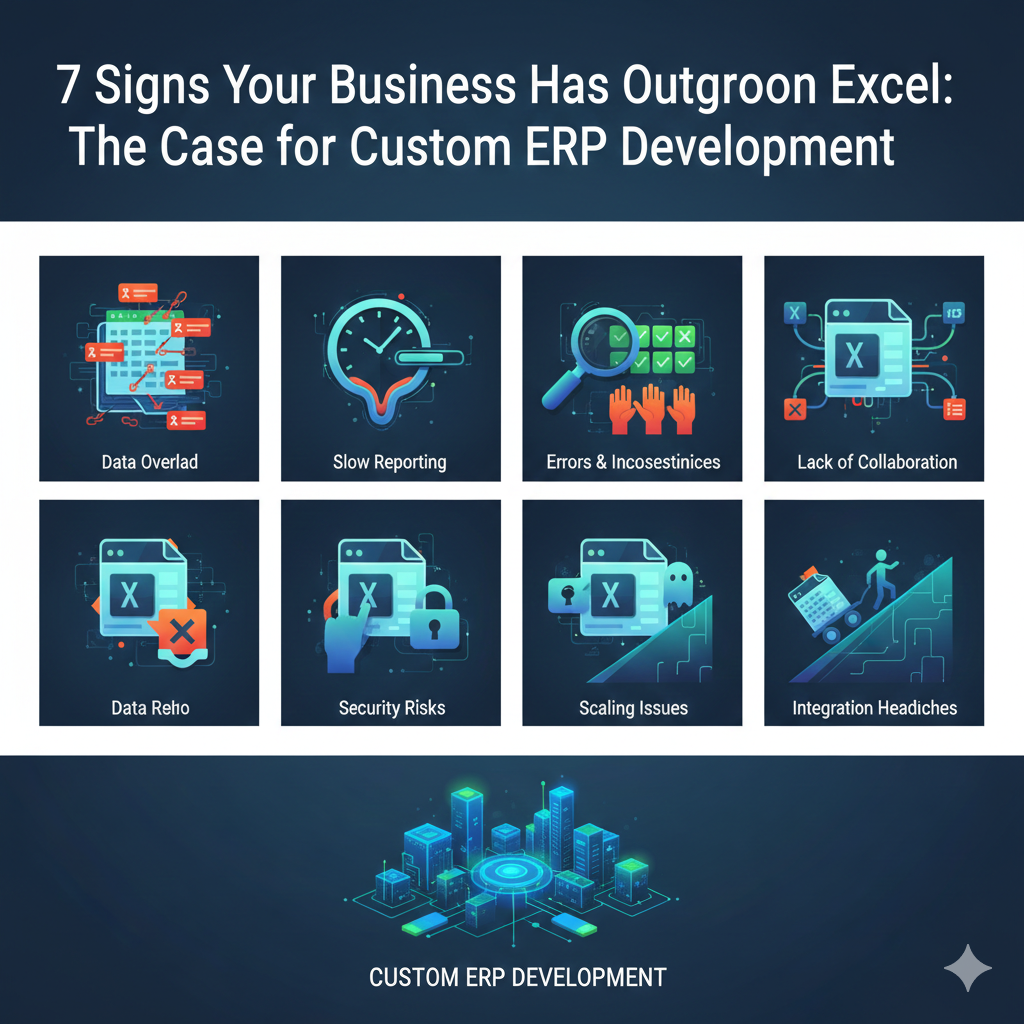
For many startups and mid-sized firms, Microsoft Excel is the "hero" software that keeps the lights on. It’s flexible, familiar, and virtually free. However, there comes a tipping point where a spreadsheet stops being an asset and starts becoming a liability.
+1
When your business logic is buried in a 50MB file named MASTER_V4_FINAL_USE_THIS_ONE.xlsx, you’ve officially outgrown the grid. Here are the seven signs it’s time to trade your workbooks for a custom Enterprise Resource Planning (ERP) system.
1. The "Single Point of Failure" Risk
If your entire operations rely on one person—the "Excel Wizard"—who is the only one who understands the nested VLOOKUP and INDEX-MATCH formulas, your business is at high risk. If that person leaves or the file becomes corrupted, your data is effectively hostage.
2. Version Control Chaos
When multiple departments (Sales, Inventory, Finance) maintain their own versions of the same data, "The Truth" becomes subjective. You spend more time in meetings arguing over whose numbers are correct than actually making decisions based on those numbers.
3. Lack of Real-Time Visibility
Excel is a rearview mirror; it shows you what happened when the data was manually entered hours or days ago. A custom ERP provides a real-time dashboard, allowing you to see inventory levels, cash flow, and lead statuses as they happen.
+1
4. Manual Data Entry Fatigue
If your employees spend hours every week copy-pasting data from emails, Shopify, or HubSpot into a spreadsheet, you are paying human wages for "robot" work. Custom ERPs automate these integrations, reducing human error and freeing up your team for high-value tasks.
5. Security and Compliance Gaps
Excel was not built for granular security. You can password-protect a sheet, but you generally cannot limit a user so they can see "Customer Names" but not "Profit Margins." In a custom ERP, Role-Based Access Control (RBAC) ensures everyone sees exactly what they need—and nothing more.
6. Performance "Lag" and Crashes
Excel starts to struggle once you hit tens of thousands of rows, especially with complex calculations. If your screen freezes for 30 seconds every time you hit "Save," the software is no longer capable of handling your data volume.
7. The Integration Wall
As you scale, you likely use specialized tools: Slack for comms, Stripe for payments, and Salesforce for CRM. A spreadsheet is an island; a custom ERP acts as a central nervous system, connecting all these tools into a single, cohesive workflow.
+1
Why Custom ERP Over "Off-the-Shelf"?
While platforms like SAP or Oracle exist, they often force you to change your business processes to fit their software. Custom ERP development flips the script: the software is built to mirror your specific, proven workflows.