Technology
AI Model Training vs. Fine-Tuning vs. RAG: Which Approach Fits Your Business?
U
Uzair Khan
Chief Systems Architect
February 20, 2026
2 min read
In the rapidly evolving landscape of 2026, the question for most businesses is no longer if they should use AI, but how to customize it for their specific data.
With global AI spending nearing $2.5T, choosing the wrong architecture—Full Model Training, Fine-Tuning, or Retrieval-Augmented Generation (RAG)—can lead to "context bloat," massive cost overruns, or AI "hallucinations" that damage your brand. Here is a definitive guide to which approach fits your business.
1. Full Model Training: The "Building from Scratch" Approach
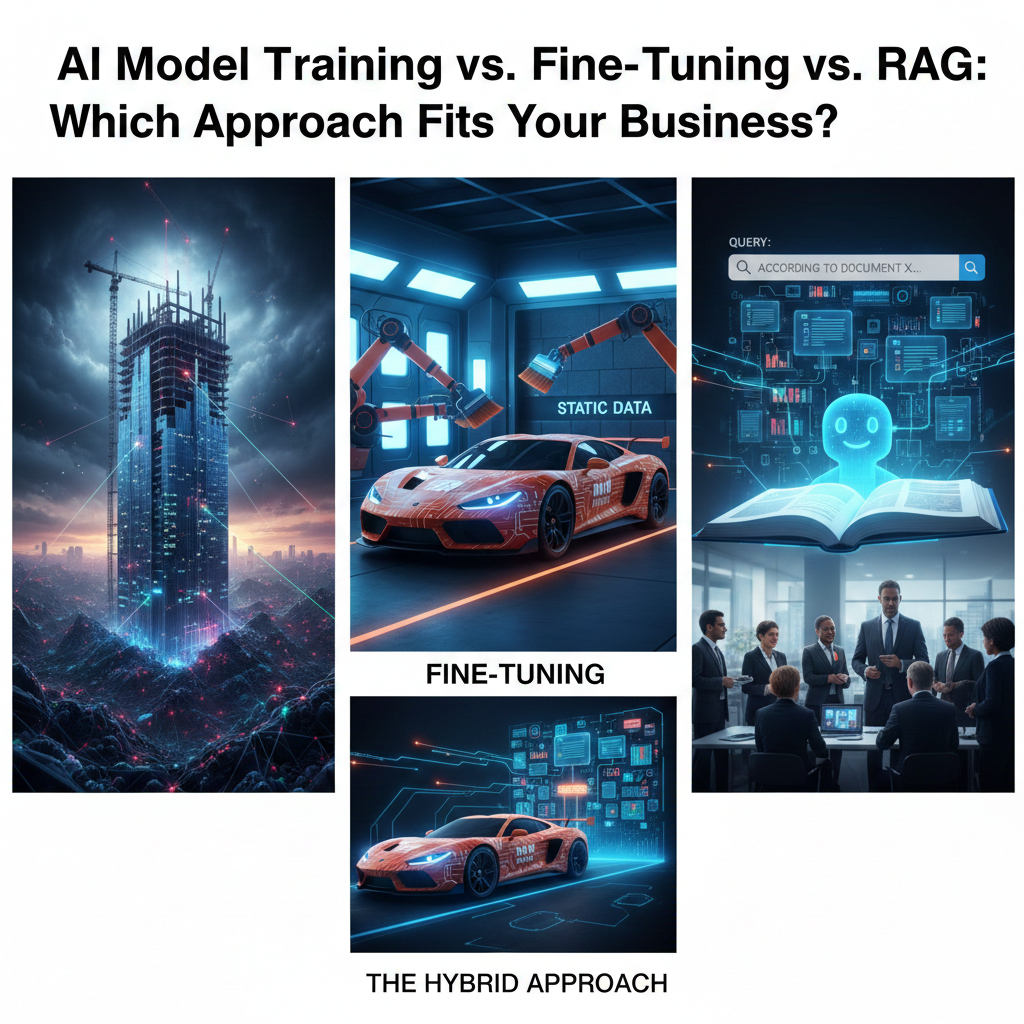
Full training involves teaching a model from zero using massive datasets (trillions of tokens). For 99% of businesses, this is not the answer.
When to use it: You are building a "Sovereign AI" for a nation or a foundation model for a completely unique industry (e.g., specialized protein folding or deep-sea seismic data) where no base model currently exists.
The Cost: Tens of millions of dollars in compute (GPU clusters like NVIDIA Blackwell B200s) and months of data curation.
Risk: Extremely high. By the time you finish training, the technology may have moved on.
2. Fine-Tuning: The "Specialized Training Camp"
Fine-tuning takes a pre-existing model (like Llama 3 or GPT-4) and adjusts its internal "weights" using a smaller, curated dataset.
The Goal: To change the behavior, style, or format of the model.
Best For: * Brand Voice: Ensuring your AI sounds exactly like your marketing team.
Strict Formats: Forcing the AI to always output structured JSON or specific medical reports.
Niche Jargon: Teaching the model the specific "slang" or technical acronyms of a specialized field like patent law.
The Catch: Once trained, the knowledge is static. If your product prices change tomorrow, a fine-tuned model will still "remember" yesterday’s prices.
3. RAG (Retrieval-Augmented Generation): The "Open-Book Exam"
RAG is the gold standard for most enterprise applications in 2026. Instead of "memorizing" data, the AI is given a "library card" to look up information in your company's live databases before answering.
The Goal: To provide accurate, up-to-date, and traceable information.
Best For:
Dynamic Data: Product catalogs, HR policies, or financial market news that changes daily.
Compliance: Since RAG can cite its sources (e.g., "According to Document X..."), it is far easier to audit for the EU AI Act.
Security: You can grant or revoke the AI's access to specific folders instantly without retraining the model.
The Catch: It can be slower at runtime because the AI has to "search" before it speaks.